
This post contains affiliate links. Purchases made through these links earn The Ergo Workspace a small commission at no extra cost to you. All product recommendations are based on genuine design merit.
Decorating around a TV works when you get three things right first: mount it at the correct height (screen center at 42–48″ from the floor), anchor it with a console at least 6–8 inches wider on each side, and add bias lighting behind the screen to kill the “black hole” effect. Everything else — wall art, plants, shelves, style formulas — builds on those three foundations. This guide gives you the exact numbers, room-by-room rules, and a style-matching system no competitor covers.
Knowing how to decorate around a TV is one of those things that sounds simple until you’re actually standing in front of a blank wall with a mounted screen and absolutely no idea where to start. The TV is up. The room still looks wrong. And every guide you’ve read either hands you a vague list of “add plants and art” or sends you straight to a shopping page without explaining the logic behind any of it.
Here’s the honest answer: decorating around a TV isn’t about finding the right objects. It’s about making three foundational decisions in the right order — height, console scale, and lighting — and then choosing one style formula that actually fits the room you already have. Get those three right first and even a simple, low-budget setup looks intentional. Skip them and no amount of gallery walls or sculptural busts will save it.
This guide is built around the specific gaps that every other resource in this space misses: a lighting strategy that transforms a TV wall in one step, room-by-room rules that change the entire approach, a style-matching system so you stop guessing which formula fits your aesthetic, and a direct answer to the most-searched TV décor question nobody properly addresses — what actually goes on the console surface itself. We cover all of it, in order, with real dimensions and zero vague advice.

No products pushed until you’ve earned the right to shop for them. The content comes first — every formula, dimension, and decision framework you need. The curated shopping section lives at the end, organized by category, for when you’re ready to buy with intention.
- The Three Foundations: Height, Scale & Lighting
- The Missing Piece: Lighting Strategy Nobody Talks About
- What to Put ON the Console (The Question Everyone Actually Has)
- The Style-Matching Guide: Which Formula Works for YOUR Room
- The 8 Style Formulas: Pick One and Commit
- Room-by-Room Rules: Living Room vs. Bedroom vs. Studio
- The Samsung Frame TV: Its Own Set of Rules
- Seasonal Refreshes Without Starting Over
- The 6 Most Costly Mistakes
- The Designer’s Cheat Sheet
- The Curated Shopping Guide
- FAQ
How to Decorate Around a TV: The Three Foundations

When you decorate around a TV, everything else — the style formulas, the lighting choices, the console objects — is secondary to these three foundations. Get them wrong and nothing you add on top will fix it. Get them right and even a modest collection of objects will look intentional.
Foundation 1 — TV Height: The 42–48 Rule
The center of your TV screen should sit 42 to 48 inches from the floor. That’s seated eye level for most adults. If your neck tilts up after 20 minutes of watching, the TV is too high — and that is the single most common TV wall error, full stop.
Find Screen Height
Measure the actual screen height (not diagonal). A 65″ TV screen is approximately 32″ tall.
Divide by Two
Half the screen height = 16″. This is the distance from the screen center to the bottom edge.
Subtract from 48″
48 − 16 = 32″ from floor to TV bottom edge. That’s your mount target.
Mounting above a fireplace nearly always puts the TV 12–20 inches too high. The firebox plus mantel typically lands the TV bottom edge at 42″+ before accounting for the screen itself. If it’s your only option, use a tilting wall mount angled 15–20 degrees downward and keep seating at least 10 feet back.
Foundation 2 — Console Scale: The 6-Inch Rule
Your console must extend a minimum of 6 inches beyond each side of the TV — ideally 8–10 inches. A 65″ TV is approximately 57″ wide, so you need a console of at least 69–77 inches. When the TV overhangs the console, the eye reads the whole setup as unstable and unfinished. When the console extends properly, the composition reads as grounded and intentional.
The Problem
- 65″ TV on a 48″ console
- TV overhangs 8.5″ per side
- Looks unstable, unanchored
- No amount of styling fixes this
The Fix
- 65″ TV on a 72–80″ console
- 7–11″ extension per side
- Looks intentional, grounded
- Every formula works from here
After placing the TV, there should be no more than three fingers of visible space between the top of the console and the bottom of the TV bezel. More gap looks like hovering. Less and the console disappears under the screen.
Foundation 3 — Bias Lighting: The Step Everyone Skips
This is covered in full in the next section because it deserves it. But understand it belongs here alongside height and scale — not as an accessory, but as a foundation. It’s the single fastest way to make a TV wall look finished, and almost no design guide mentions it at all.
- Timeless Paint Colors That Never Go Out of Style — the wall color behind your TV changes everything about how the screen reads in the room.
Decorating Around a TV: The Lighting Step Everyone Skips

Here is the gap that separates every professionally styled TV wall from every amateur one: ambient lighting around and behind the screen. It’s the most overlooked element when people decorate around a TV — everyone focuses on what to hang on the wall and forgets that light is what makes walls come alive in the evening, which is exactly when you’re using your TV.
“A TV emits cold, high-contrast light in an otherwise dark room. Your brain reads that as a black hole punched through the wall. The fix costs $25 and takes 15 minutes.”
— The Ergo WorkspaceBias Lighting: The $20–40 Fix That Looks Like a $500 Upgrade
Bias lighting is an LED strip mounted to the back of the TV, facing the wall. The glow diffuses around the edges of the screen and reduces perceived contrast. The result: the TV appears to float softly in the room rather than punch a hole in it. It also measurably reduces eye strain during evening viewing.
Choose Warm White (2700–3000K)
Warm white bias light harmonizes with interior lighting. Cool white (4000K+) creates a visual conflict the eye reads as unsettling.
Apply Around the TV Perimeter
Stick the LED strip around the back edge of the TV. Most strips include adhesive backing. Cover all four sides for even glow.
Plug Into the TV’s USB Port
The bias light turns on and off automatically with the screen. Zero habit change required. Total cost: $20–40.
Flanking Lamps: The Layer Most Rooms Are Missing
Floor lamps or wall sconces placed on either side of the TV serve two purposes simultaneously: they act as the vertical flanking elements that anchor the TV wall, and they add warm ambient light that makes the entire zone feel cohesive. The lamp should be tall enough that its light source sits above the console surface — a lamp that only reaches console height disappears behind the furniture.
Accent Lighting on Shelves
If you’re using the floating shelf sandwich formula, add small puck lights or LED strip lighting underneath each shelf. This illuminates the objects below and adds layered depth to the entire wall composition. It’s the difference between a shelf that looks like storage and one that looks like a gallery.
Every finished TV wall needs three light sources: (1) Bias light behind the screen. (2) Warm ambient source on at least one side — lamp or sconce. (3) Overhead ceiling light on a dimmer. Get all three and the room looks designed. Miss any one and something always feels slightly off at night.
- Create Your Perfect Ergonomic Home Office — lighting principles for screens apply directly to both TV walls and home office setups.
What to Put ON the Console

This is the most-searched question about how to decorate around a TV that almost nobody answers directly. Style the wall all you want — if the console surface looks like a Best Buy display, the room still feels unfinished. Here are the rules.
The Two-Thirds Rule
Décor should cover roughly two-thirds of your console’s visible surface width, leaving one-third as negative space. On a 72″ console, that’s approximately 48″ of styled area and 24″ of breathing room. Trying to fill the whole surface creates clutter. Leaving it entirely empty makes the console look like a shelf waiting for boxes.
The Rule of Three Heights
Every console vignette needs objects at three height levels: tall (18–24″), medium (10–14″), and low (4–6″). Arrange them in an odd-numbered group — three or five objects, never two or four. The eye reads even numbers as static; odd numbers create natural visual movement.
The Tray Trick
A decorative tray on one section of the console corrals remotes and small tech accessories so they look intentional rather than scattered. It also acts as a visual base that makes objects inside read as one grouped element. Use a tray with visual weight — woven seagrass, concrete, marble, or lacquered wood. A cheap plastic tray negates the effect entirely.
What NOT to Put on the Console
- Objects taller than the TV’s bottom edge — anything that competes with screen height creates visual chaos
- Too many small objects — five scattered pieces reads as flea market; three deliberate ones reads as designer
- Books standing upright without a bookend — a lone tipping book makes the whole surface look unattended
- Objects blocking the IR sensor — keep taller pieces away from the center bottom bezel where the receiver typically sits
- Must-Have Accessories for Guys: The Secret to a Stylish Space — sculptural objects that work especially well on console surfaces in masculine or modern spaces.
The Style-Matching Guide: Which Formula Works for YOUR Room

The reason most TV walls don’t work isn’t that people chose the wrong formula. It’s that they chose a formula without checking whether it fits the room they already have. A symmetrical gallery wall looks extraordinary in a transitional room. In a spare Scandinavian space it looks like a panic response. Here’s a direct matching system.
| Your Room Style | Best Formula | Avoid | Key Material |
|---|---|---|---|
| Modern / Minimalist | Single Statement Piece or Dark Wall Camouflage | Symmetrical Gallery Wall | Matte black, concrete, white |
| Scandinavian | Floating Shelf Sandwich with natural objects | Neon Accent | Light wood, linen, greenery |
| Mid-Century Modern | Plant Flanks + low-profile console | Heavy symmetrical gallery | Walnut, brass, terracotta |
| Traditional / Transitional | Symmetrical Gallery Wall or Built-In Illusion | Single Neon Accent | Gold frames, dark wood, linen |
| Eclectic / Maximalist | Asymmetrical gallery + mixed shelf objects | Single Statement Piece | Mixed metals, pattern, texture |
| Industrial / Masculine | Dark Wall Camouflage or Neon Accent | Symmetrical floral gallery | Matte black, concrete, leather |
| Coastal / Bohemian | Plant Flanks + woven texture objects | Hard symmetrical gallery | Natural fiber, rattan, soft white |
Not Sure Which Style You Are?
Take the quiz and come straight back to the matching table above.
Take the Interior Design Style Quiz →The 8 Style Formulas: Pick One and Commit

These are the eight proven approaches for how to decorate around a TV wall. The cardinal rule: pick one and execute it completely. Two formulas blended at half-commitment always reads as indecision. One formula done fully always reads as intentional.

The Symmetrical Gallery Wall
Frame the TV with coordinated art panels on both sides. This is the most forgiving approach — our brains read symmetry as intentional even when execution isn’t flawless.

The Asymmetrical Art Lean
Lean an oversized canvas or framed piece against the wall beside — not behind — the TV. The casual lean signals confidence and works especially well with contemporary or artist-studio aesthetics.

The Floating Shelf Sandwich
Install floating shelves above and on the flanking wall space. The TV becomes part of a curated shelfscape rather than an isolated screen — the most versatile formula for renters.

The Dark Wall Camouflage
Paint the TV wall a deep, saturated color — charcoal, forest green, navy, near-black. The TV’s black bezel naturally absorbs into the background. You’re not hiding the screen; you’re making the entire wall intentional.

The Single Statement Piece
One large-scale artwork — minimum 48″ wide — positioned to one side of the TV. The art becomes the room’s anchor; the TV becomes secondary. Restraint is the entire point of this formula.

The Plant Flanks
Two floor plants placed symmetrically on each side of the console. Plants add organic texture, vertical movement, and warmth to what is otherwise a wall of hard rectangular objects.

The Tech-Savvy: Frame TV
The Samsung Frame TV is designed to look like a framed canvas when switched off. When styled correctly, guests genuinely cannot tell it’s a TV. The formula demands a deep wall color, a flush mount, and minimal surrounding décor.

The Built-In Illusion
Frame the TV inside floor-to-ceiling shelving. The screen disappears inside a wall of intentional storage and display. Modular bookcases on either side of the console replicate custom built-ins at a fraction of the cost.
Decorate Around a TV by Room: The Rules Change by Space

Every guide on how to decorate around a TV writes as if there’s one universal “living room.” But a TV in a bedroom has completely different ergonomic and design constraints than one in an open-concept space or a studio apartment. Here are the rules by room type — because the formula that works in one space actively fails in another.
Primary Viewing Space
Screen center at 42–48″. Console extends 6–10″ per side. Flanking elements are non-negotiable. All 8 formulas work — focus on matching formula to existing style before buying anything.
Lower, Warmer, Simpler
Screen center at 36–42″ (reclined viewing). Keep flanking décor minimal — one or two objects maximum. Heavy gallery walls in a bedroom feel like anxiety. Bias lighting especially important here.
The Multitasking Wall
TV wall anchors the entire room. Built-In Illusion formula acts as a room divider. Keep console surface minimal. One tall plant per side is more impactful than a gallery wall in tight spaces.
Multiple Sightlines Problem
TV wall is visible from kitchen, dining, and entry. Console back, flanking profiles, and cable management all need attention from multiple angles. Built-In Illusion creates a defined zone that reads from every direction.
Screen Serves Two Masters
Screen center at 24–28″ above desk surface. Console becomes desk. Keep décor functional — warm lamp on one side, clean shelving on the other. Avoid gallery walls that distract during work hours.
No Rules. But Still Rules.
The man cave is where restraint goes to die — and that’s fine, if it’s intentional. Dark wall camouflage is the anchor move: deep charcoal or near-black behind the TV makes the screen disappear into the wall. Neon accent lighting on one side, a low-profile console with clean storage for gear, and one strong sculptural object are all you need. Avoid mixing more than two accent colors or the room reads as a bar rather than a designed space.
- Modular Sofas for Small Spaces: Brilliant Solutions for Compact Living — how you arrange seating relative to the TV wall matters as much as the wall itself.
The Samsung Frame TV: Its Own Set of Rules

The Samsung Frame TV is the most-searched “TV as art” product on the market. It has a devoted following — for good reason. But it has its own design rules that nobody explains clearly, and doing it wrong wastes the entire premise of the product.
What Makes It Different
The Frame TV is designed to look like a framed canvas when switched off. The matte anti-glare screen kills the reflective “screen” quality that betrays most TVs as technology. When styled correctly, guests genuinely cannot tell it’s a TV until you turn it on.
Do This
- Mount on a deep, saturated wall color — charcoal, forest green, terracotta
- Use the official Samsung no-gap mount (flush = art; gap = tech)
- Choose a magnetic bezel that matches your room’s dominant frame finish
- Keep flanking décor minimal — one plant, one sconce, one restrained vignette
Avoid This
- Mounting on a white or light neutral wall — the bezel reads as a floating black frame
- Using a standard TV wall mount with visible gap behind the screen
- Surrounding it with a busy gallery wall — defeats the art-display premise entirely
- Keeping the default black bezel in a room with warm or natural finishes
Seasonal Refreshes Without Starting Over

Once you’ve learned how to decorate around a TV and set it up properly, the wall needs periodic refreshing — but nobody covers how to update it without spending $300 or disrupting the whole composition. Here’s the system.
Think of your TV wall in two layers: the fixed layer (console, wall mounts, large art, bookcases, flanking lamps) set once and rarely touched, and the seasonal layer (console surface objects, shelf styling, small art pieces). The fixed layer does 80% of the visual work. Swapping just the seasonal layer changes the room’s feeling without touching anything structural.
- ◆ Dried pampas grass replaces greenery
- ◆ Chunky candle added to console tray
- ◆ Art prints shift to monochromatic charcoal tones
- ◆ Flowering stem or fresh eucalyptus
- ◆ Console objects lighten to white or cream
- ◆ Swap to lighter linen-toned art prints
- ◆ Warm terracotta tones added
- ◆ Small pumpkin or gourd beside vignette
- ◆ Switch to amber-toned candles throughout
- ◆ One holiday addition only — not a full takeover
- ◆ Single candle cluster beside existing vignette
- ◆ One seasonal object, not a full swap
Not Sure What Style Works for Your Space?
Take the free Patio Style Quiz and discover which design direction suits your home — inside and out.
Take the Free Quiz →Decorating Around a TV: The 6 Most Costly Mistakes
❌ TV Hung Too High
- Screen center above 54″ from floor
- Neck craning, eye fatigue after 20 min
- The room feels off and you don’t know why
✅ The Fix
- Screen center at 42–48″ — no exceptions
- Use tilting arm (10–15°) as an interim fix
- In bedroom: lower to 36–42″ for reclined viewing
❌ Console Too Narrow
- TV overhangs more than 4″ per side
- Setup looks precarious and unbalanced
- No styling decision fixes wrong proportions
✅ The Fix
- Console = TV width + 12–20″ minimum
- 65″ TV (57″ wide) → 69–77″ console
- Wider is always the right direction
❌ No Lighting Strategy
- Overhead light only in the room
- Harsh screen contrast at night
- Room feels unfinished regardless of daytime styling
✅ The Fix
- Bias light behind TV ($20–40)
- Warm lamp flanking one or both sides
- Overhead ceiling light always on a dimmer
❌ Art Hung Too High Above TV
- 12″+ gap between TV top and gallery bottom
- Art floats disconnected from console zone
- Reads as two separate, unrelated walls
✅ The Fix
- Art bottom edge: 4–6″ above TV top only
- Gallery should feel like one vertical composition
- Art top: max 84″ from floor
❌ Two Unrelated Style Formulas
- Neon sign + gallery wall + plants + sculpture
- Each element competes — nothing wins
- The room looks exhausting, not styled
✅ The Fix
- Pick one formula and execute it fully
- Second formula elements at 4:1 ratio max
- One formula done well beats two done halfway
❌ Exposed Wires on a Clean Wall
- Visible HDMI loop below the mounted TV
- Undoes every styling decision around it
- Reads as unfinished from across the room
✅ The Fix
- $35 in-wall power kit — one afternoon install
- Renters: paintable cord cover raceways ($15–25)
- Highest ROI improvement on any TV wall
- Bathroom Peel and Stick Wallpaper: 7 Designer Tricks That Look High-End — the same removable wallpaper techniques work perfectly for TV accent walls with zero wall damage.
The Designer’s Cheat Sheet
TV Height
Center at 42–48″ from floor.
Bottom = 48 − (screen H ÷ 2).
Bedroom: 36–42″.
Console Width
TV width + 12–20″.
Min 6″ extension per side.
Ideal: 8–10″ per side.
Art Placement
Bottom: 4–6″ above TV top.
Top: max 84″ from floor.
Width ≤ TV screen width.
Shelf Rules
8–12″ above TV top.
Max 8″ deep.
Puck lights underneath.
Plant Height
Min 60% of TV height.
Ideal: canopy = TV top.
12–18″ from console edge.
Console Objects
Style ⅔ of surface width.
3 heights: tall/med/low.
Odd numbers: 3 or 5 only.
Lighting
Bias: 2700–3000K warm white.
Lamp above console height.
Overhead always on dimmer.
Viewing Distance
Optimal: diagonal × 1.5–2.5.
65″ TV → 8–13 feet away.
Min: diagonal × 1.2.
The Curated Shopping Guide
Every product below was selected because it solves a specific problem covered in this guide. Budget, mid-range, and upgrade options in each category — organized by the formula it supports.
🪵 TV Consoles — Foundation Formula
 Budget
Modern Low-Profile TV Stand
Clean lines, two-tone finish. Solves the overhanging TV problem on a tight budget. Works up to 65″ TVs.
Shop on Amazon → Mid-Range
Solid Wood Media Console
Warm walnut finish, proper proportions for 55–75″ TVs. Storage without visual bulk.
Shop on Amazon →
🏠 Entertainment Centers — Built-In Illusion Formula
 Budget
Tall Bookcase — Buy Two, Flank the TV
The DIY built-in solution. Two bookcases flanking your existing console replicates custom millwork for a fraction of the cost.
Shop on Amazon → Mid-Range
Open-Back Tall Bookcase
Lighter visual weight. Better for smaller rooms where a heavy flanking pair would feel oppressive.
Shop on Amazon →
🖼️ Wall Art — Symmetrical Gallery & Statement Formulas
 Budget
Gallery Wall Frame Set
Coordinated frames in mixed sizes. Solves the random-finish problem in one purchase. Renter-friendly with Command strips.
Shop on Amazon →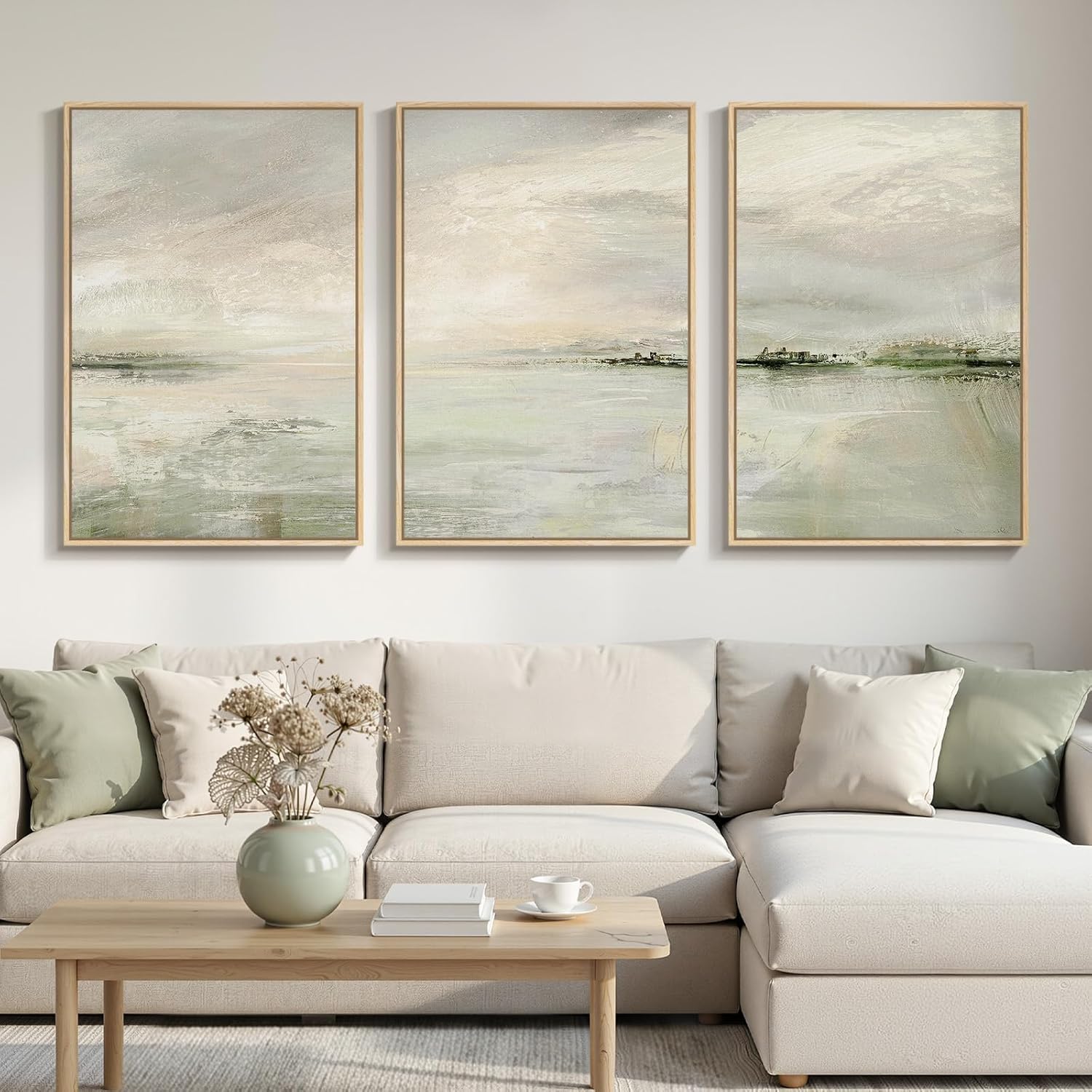 Mid-Range
3-Piece Coordinated Art Set
Ready-to-hang triptych. Same finish, same scale. The easiest way to nail symmetry without sourcing individual frames.
Shop on Amazon →
📚 Floating Shelves — Shelf Sandwich Formula
 Budget
Floating Wall-Mount Shelf
Clean bracket-free design. No visible hardware. Install 8–12″ above the TV top. Perfect for books and small objects.
Shop on Amazon → Mid-Range
Substantial Floating Shelf
Deep enough for layering books and objects at three heights. The shelf with real visual presence that reads from across the room.
Shop on Amazon →🏺 Sculptural Objects — Console Styling Formula
 Budget
Roman Bust — Tall Element
The tall anchor in a console vignette. Classic, architectural, works across modern and traditional. Stack on books to add 4″ of height.
Shop on Amazon → Mid-Range
Larger Roman Bust — Wide Consoles
For consoles 70″+, the larger scale holds its own. The piece that makes a console look curated rather than assembled.
Shop on Amazon →🌿 Flanking Plants — Plant Flanks Formula
 Budget
Artificial Fiddle Leaf Fig
No guilt, no re-potting. Convincing from 6 feet. Place in a real ceramic pot for full credibility.
Shop on Amazon → Mid-Range
Silk Fiddle Leaf Fig — Fuller Canopy
More realistic texture and fuller canopy. The extra foliage density is what makes this read as real from across the room.
Shop on Wayfair →🔊 Soundbars — Visual Layer + Audio
 Budget
Slim TV Soundbar
Fills the visual gap between TV and console while dramatically improving audio. Sleek profile doesn’t disrupt console styling.
Shop on Amazon → Upgrade
Bose SoundLink
When audio quality matters as much as aesthetics. Clean design that sits beautifully on any console without screaming “tech gadget.”
Shop on Amazon →💡 Accent Lighting — Neon Formula + Ambient Layer

Decorate Around a TV: Your Questions Answered
Where to Start Today
Every TV wall that looks effortlessly designed started with the same three decisions made in the right order. Height first — measure and confirm your screen center is at 42–48 inches before touching anything else. Console scale second — if your console is the wrong width, no amount of styling fixes it. Lighting third — add bias light behind the screen and a warm lamp on at least one side before you call the wall done.
Then choose one formula from the eight above that matches your existing room style using the matching table, and execute it completely. One formula done well outperforms two formulas done halfway every single time.
“The shortcut to a well-styled home is knowing the rules before you start spending.”
Get The Decorator’s Black Book →- Take the Interior Design Style Quiz — then come straight back to the style-matching table to find your exact formula.
CATCH THE LATEST IN HOME DECOR TRENDS:
Steal These 16 Expert-Approved Decorating Secrets

How To Accessorize Your Living Room
Small Space? 10 Ways To Make A Room Appear Bigger

Make Your space Look Expensive
GET CAUGHT UP ON ALL THE INSPIRING DECOR TIPS:
18 Fresh Decorating Ideas To Update Your Fireplace

How to Make a Gallery Wall: The Complete Step-by-Step Guide (Even If You’ve Never Hung a Picture)
